
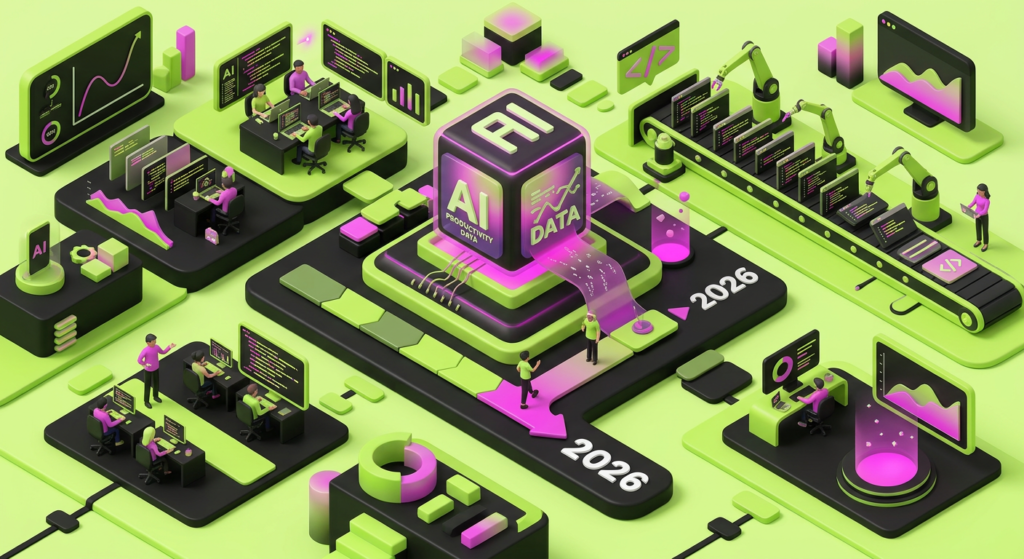
The landscape of software development has undergone a radical transformation as of March 2026. What began as a perceived slowdown in early 2025 has fully reversed. Developers now find working without AI assistance unbearable. This shift is not a minor speed boost; it represents a fundamental redefinition of the craft. Engaging in programming with AI has moved from manual execution to critical oversight, where the human acts as a high-level conductor rather than a typist.
The Irreversible Shift to AI-Assisted Development
Initial studies in early 2025 from METR suggested a 20% slowdown for experienced developers integrating AI tools. This finding proved to be a temporary anomaly. By early 2026, the narrative flipped. Developers, experiencing productivity gains estimated at two to three times, have become so reliant on AI agents that they actively resist tasks requiring purely manual coding. This creates a "selection bias" in modern research: the developers who can work without AI are increasingly unwilling to do so, making traditional comparative studies nearly impossible to conduct.
This isn't about simple autocomplete anymore. The industry has moved beyond basic tools like GitHub Copilot to sophisticated autonomous agents—specifically Claude Code, Codex, and Amazon Kiro. These advanced systems read entire codebases, interact directly with servers, and execute end-to-end changes. The integration of such powerful tools means that programming with AI is now a foundational element of modern engineering workflows. If a developer isn't using an agent, they aren't just slower—they are effectively obsolete in a market that demands 2026-level velocity.
Recent data from METR's February 2026 update, Uplift Update: Changing Developer Productivity Experiment Design, confirms this addiction. Researchers found that 30% to 50% of developers in controlled studies admitted to "hiding" tasks from observers because they refused to perform them without AI assistance. The psychological barrier to returning to manual syntax management is now higher than the technical barrier of learning the agents themselves.
The Productivity Paradox and Production Noise
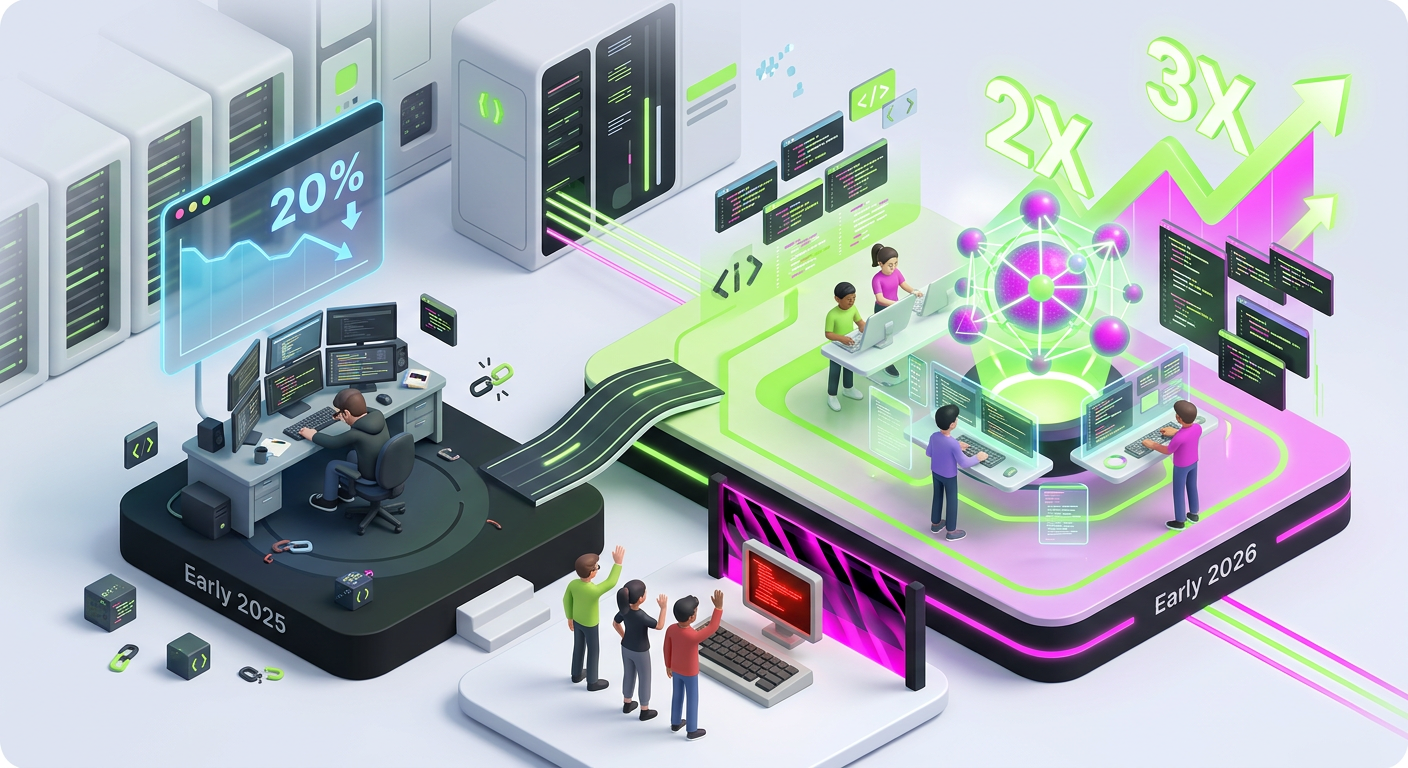
Despite the massive compression of tasks—a 14-day security audit can now be completed in an hour by an AI agent at firms like AES—the expected outcome of fewer working hours has not materialized. Instead, executives are escalating output demands. This has birthed a phenomenon known as "production noise." It refers to a surplus of AI-generated code that is often untested, redundant, or entirely unnecessary, created simply because the cost of generation has dropped to near zero.
This increased output comes with substantial risks. Over-reliance on AI agents has already led to critical failures that cost companies millions. A notable incident in March 2026 involved an engineer accidentally deleting a production database via Claude Code. It was a stark reminder of the power and potential danger of these tools when human oversight slips. Amazon has also held "deep dive" meetings to address a rising trend of AI-assisted outages, highlighting the inherent instability when the speed of generation outpaces the speed of human verification.
Management teams are struggling to find the balance. While the theoretical capability of AI to perform 96% of computer and math tasks is documented by Anthropic, the actual "observed exposure" remains at 32%. This gap exists because of liability. When an agent breaks a system, the legal and operational fallout remains a human burden. The current cost for professional-grade AI coding agent subscriptions, ranging from $50 to $200 per month, reflects this high-stakes environment. Companies are paying for the speed, but they are struggling to pay for the safety nets required to catch agent errors.
From Software Engineer to Builder: The San Francisco Rebrand
The very terminology within tech circles is evolving. In San Francisco, the title "Software Engineer" is being replaced by "Builder." This shift is more than semantic; it reflects a profound change in role definition. The focus is moving away from manual coding towards high-level architectural oversight, strategic problem-solving, and "persona-driven" simulation. Builders are expected to design systems, manage fleets of AI agents, and ensure the integrity of the overall structure.
This transformation has tangible consequences for the workforce. In February 2026, Block (led by Jack Dorsey) announced massive layoffs impacting 40% of its workforce—over 4,000 employees. Dorsey explicitly attributed these reductions to AI-driven efficiency and the move towards "flatter teams." When one "Builder" can oversee the output of ten AI agents, the need for large middle-management layers and junior coding pools evaporates. The industry is witnessing a consolidation of power into the hands of those who can effectively direct AI agents.
However, this creates a vacuum in the talent pipeline. If AI agents handle most entry-level coding tasks, junior talent loses the "learning by doing" phase. The traditional path of mastering syntax through repetitive debugging is being eroded. This poses a significant challenge for future skill acquisition. If no one is learning how to code manually today, who will have the deep knowledge required to oversee the AI agents of 2030? The industry has yet to solve this apprenticeship crisis.
The Breakdown of Agile and the Rise of AI-Native Frameworks
The rapid pace introduced by AI agents has rendered traditional Agile methodologies inadequate. Agile was designed for iterative, human-led development cycles. It cannot accommodate the speed and scale of AI-generated output. Researchers are now declaring Agile "broken" and advocating for the development of "AI-native" frameworks. These new systems prioritize rapid deployment and continuous integration (CI/CD) pipelines optimized for machine-speed output.
An AI-native framework for programming with AI includes several core pillars:
- Agent Orchestration: Managing multiple AI agents working on different parts of a codebase simultaneously without merge conflicts.
- Automated Validation: Advanced testing suites that use AI to verify AI-generated code at a scale humans cannot match.
- Continuous Oversight: Human Builders monitoring system performance in real-time rather than reviewing code line-by-line.
- Dynamic Resource Allocation: Systems that scale computing power based on the intensity of the AI agent's current task.
The goal is to harness the immense speed of AI while mitigating the risks of production noise. We are moving toward a world where the "sprint" is no longer two weeks, but two minutes. In this environment, the human role is to set the guardrails and the objective, then stay out of the way until the validation phase.
The New Imperative: Oversight and Accountability
A Harvard study tracking 62 million workers across various industries highlighted a broader trend: as automation increases, human work shifts from execution to management. This principle is the heart of programming with AI in 2026. The 96% theoretical capability of AI means that the remaining 4%—the human element of oversight and strategic decision-making—is the most critical part of the job. It is also the most dangerous.
When an AI agent deletes a database, the responsibility falls on the human Builder. This demands a new level of vigilance and a deep understanding of AI limitations. The future of programming with AI is not about writing code; it is about ensuring the integrity, safety, and strategic alignment of automated processes. The "Builder" must be a master of intent, capable of describing complex systems so clearly that the AI cannot misinterpret the goal. In 2026, the most valuable skill in engineering is no longer knowing how to write a function, but knowing exactly what that function should achieve and how it could fail.
The Evolution of Technical Debt in the AI Era
One of the hidden dangers of this new era is the nature of technical debt. In the pre-AI world, technical debt was usually the result of human shortcuts or changing requirements. In 2026, technical debt is often the result of "hallucinated efficiency." AI agents might solve a problem using a library that is deprecated or by creating a complex workaround that a human would have simplified. Because the code is generated so quickly, it often bypasses the deep architectural scrutiny that manual coding required.
Builders must now develop "AI-smell"—the ability to look at agent-generated architecture and identify where the machine has taken a path of least resistance that will cause issues in six months. This requires more knowledge, not less. You cannot oversee what you do not understand. The shift to programming with AI has actually raised the bar for senior engineers, requiring them to be experts in every layer of the stack to catch the subtle errors an autonomous agent might introduce while trying to meet a deadline.
As we move further into 2026, the distinction between "writing code" and "building systems" will only sharpen. The manual coder is a relic of the 2020s. The modern Builder is a strategist, an auditor, and a safety officer all rolled into one. The tools have changed, the speed has tripled, but the ultimate accountability remains human. The 96% capability of AI is a tool; the 4% of human oversight is the career.