
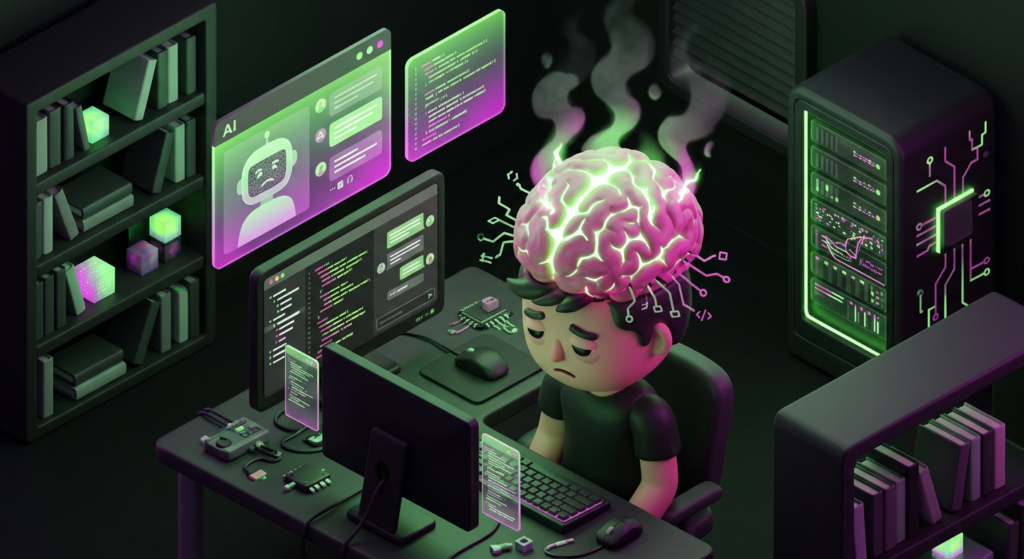
The promise of infinite productivity through programming with AI is hitting a biological wall. A new phenomenon termed 'AI brain fry' is surfacing across the software engineering landscape, characterized by acute mental exhaustion and cognitive overload. This condition, detailed in a March 2026 Harvard Business Review report by BCG researchers, challenges the narrative that AI simply reduces workload. Instead, it highlights a grueling shift in human responsibility: engineers are no longer just creators; they are now high-speed managers of digital agents.
This exhaustion stems from the 'vigilance tax' required to oversee multi-agent systems like Gas Town or Claude Code. While these tools generate code at a pace no human can match, they demand constant, high-intensity monitoring to catch hallucinations and security flaws. Programming with AI has transformed the developer's role into a relentless auditing cycle. The mental cost of context-switching between dozens of AI-generated worktrees is creating a bottleneck that silicon cannot solve.
The Data Behind the Burnout
A study conducted by BCG and UC Riverside, involving 1,488 U.S. workers, found that 14% of employees using AI regularly now suffer from brain fry. The financial impact is equally stark. Data from a January 2026 Workday survey reveals that 40% of AI’s perceived value is lost to rework and misalignment. This suggests that the speed gained in initial generation is often clawed back during the grueling verification phase.
Corporate pressure is compounding the issue. Firms like Meta have begun tying performance metrics to AI-driven output, such as the volume of lines generated. This incentivizes engineers to flood repositories with code they lack the cognitive bandwidth to properly vet. Engineer Francesco Bonacci described this as 'vibe coding paralysis'—the total exhaustion of managing a swarm of partially developed features that arrive faster than they can be understood.
Symptoms of the Vigilance Tax
Engineers experiencing this shift report 'mental static,' persistent brain fog, and a significant slowing of decision-making processes. Unlike 'workslop'—the low-effort output of unengaged users—brain fry occurs when high-performing engineers try to maintain quality standards while competing with AI speed. The result is a state of saturated attention where the developer loses the 'plot' of the architecture despite high raw output.
As the industry pivots, the focus must move from token consumption to comprehension-first development. With over 45,000 tech job cuts in early 2026 alone, the pressure to perform alongside AI is at an all-time high. However, if the human bottleneck is ignored, the next phase of software engineering may be defined more by burnout than by innovation.