
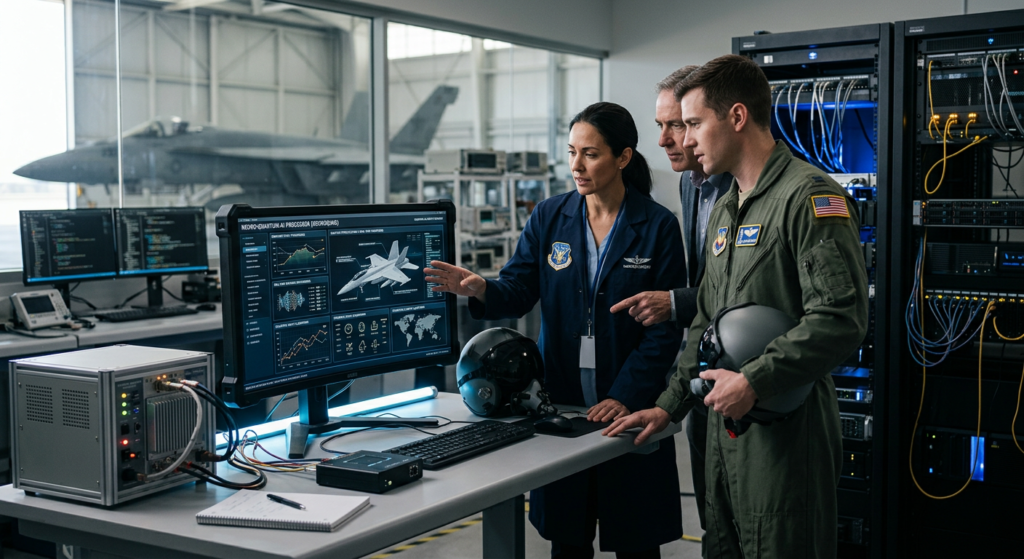
While Artificial Intelligence has dominated the global tech conversation recently, quantum computing—once the industry's most hyped frontier—seemed to have retreated into the background. The initial excitement surrounding quantum supremacy was met with the harsh reality of slow hardware development and high error rates. However, the emergence of the NEUROQUAD project suggests that quantum technology is not dormant; it is evolving into specialized, high-stakes niches where traditional computing reaches its limits.
What happened with the NEUROQUAD initiative?
NEUROQUAD is a research initiative funded by the European Defence Fund (EDF) that seeks to merge three distinct but powerful fields: neurophysiology, artificial intelligence, and quantum-inspired computing. The project is led by a consortium including Multiverse Computing, the Universidad Politécnica de Madrid (UPM), and various European air forces.
The core mission is to develop a system capable of real-time cognitive monitoring for military pilots. In high-pressure environments, such as combat or complex tactical maneuvers, a pilot's mental state—their stress levels, situational awareness, and spatial orientation—is critical. NEUROQUAD aims to build a technological symbiosis where the aircraft itself can sense if a pilot is overwhelmed and provide adaptive decision support to prevent human error.
What has actually changed in the technical landscape?
For years, the bottleneck in cognitive monitoring was the sheer volume of data. Processing complex biosignals (like brainwaves and heart rate) in real-time requires immense computational power, especially if the goal is to predict a pilot's next state rather than just reacting to it. This is where quantum computing applications re-enter the spotlight.
Instead of waiting for a full-scale universal quantum computer, NEUROQUAD utilizes quantum-inspired model-compression techniques. This is a significant shift from the theoretical "quantum boom" of the past decade. By applying quantum logic to AI models, the project can compress massive neural networks into lightweight, efficient algorithms that run in real-time within the cockpit's limited hardware.
Key technical shifts include:
- Quantum-AI Symbiosis: Using quantum algorithms to enhance the speed and accuracy of AI-based predictive models.
- Neurophysiological Integration: Moving from passive monitoring to active, adaptive systems that respond to the pilot's cognitive load.
- Hardware-Software Synergy: Integrating G.TEC’s monitoring hardware with Multiverse Computing’s quantum expertise to create a seamless feedback loop.
How does this affect the industry and the reader?
The implications of NEUROQUAD extend far beyond the cockpit of a fighter jet. While the primary focus is military aviation, the "dual-use" potential of these technologies is vast. For the average reader or industry professional, this represents a bridge between the "AI hype" and the practical utility of quantum physics.
In the civilian sector, this technology could revolutionize air traffic control, emergency response, and even healthcare. Imagine a surgeon being monitored by an AI that can detect fatigue before a mistake happens, or an air traffic controller whose workstation adjusts its interface based on their current mental bandwidth.
Furthermore, this project signals a return to technological autonomy for Europe. By developing these critical aerospace capabilities internally, the region reduces its dependence on external tech giants, fostering a local ecosystem of high-tech manufacturing and research that benefits the broader economy.
Final balance and recommendations
The NEUROQUAD project serves as a reminder that quantum computing is not a failed promise but a maturing tool. The transition from "general-purpose quantum dreams" to specific quantum computing applications in neuro-AI marks a new era of functional, human-centric technology.
For stakeholders in the telecommunications and tech sectors, the recommendation is clear: monitor the convergence of AI and quantum-inspired algorithms. The future of real-time data processing lies in the efficiency of these hybrid models. Companies should look toward "quantum-inspired" solutions as a viable way to optimize current AI workloads without waiting for the arrival of perfect quantum hardware. NEUROQUAD proves that when the stakes are high—such as in pilot safety—the integration of these advanced technologies is no longer optional; it is the new standard.