

Small B2B SaaS startups in 2026 face a brutal reality: a great product means nothing without a distribution engine, yet the cost of a full marketing team is prohibitive. The solution isn't another subscription to a generic AI writer. It is building AI agents that function as a cohesive, autonomous department. We have moved past simple prompts. Today, success lies in agentic workflows—specialized systems where different LLMs handle strategy, execution, and distribution with minimal human friction. This guide breaks down the architecture required to build a virtual marketing stack that actually converts.
The Shift from Prompts to Agentic Workflows
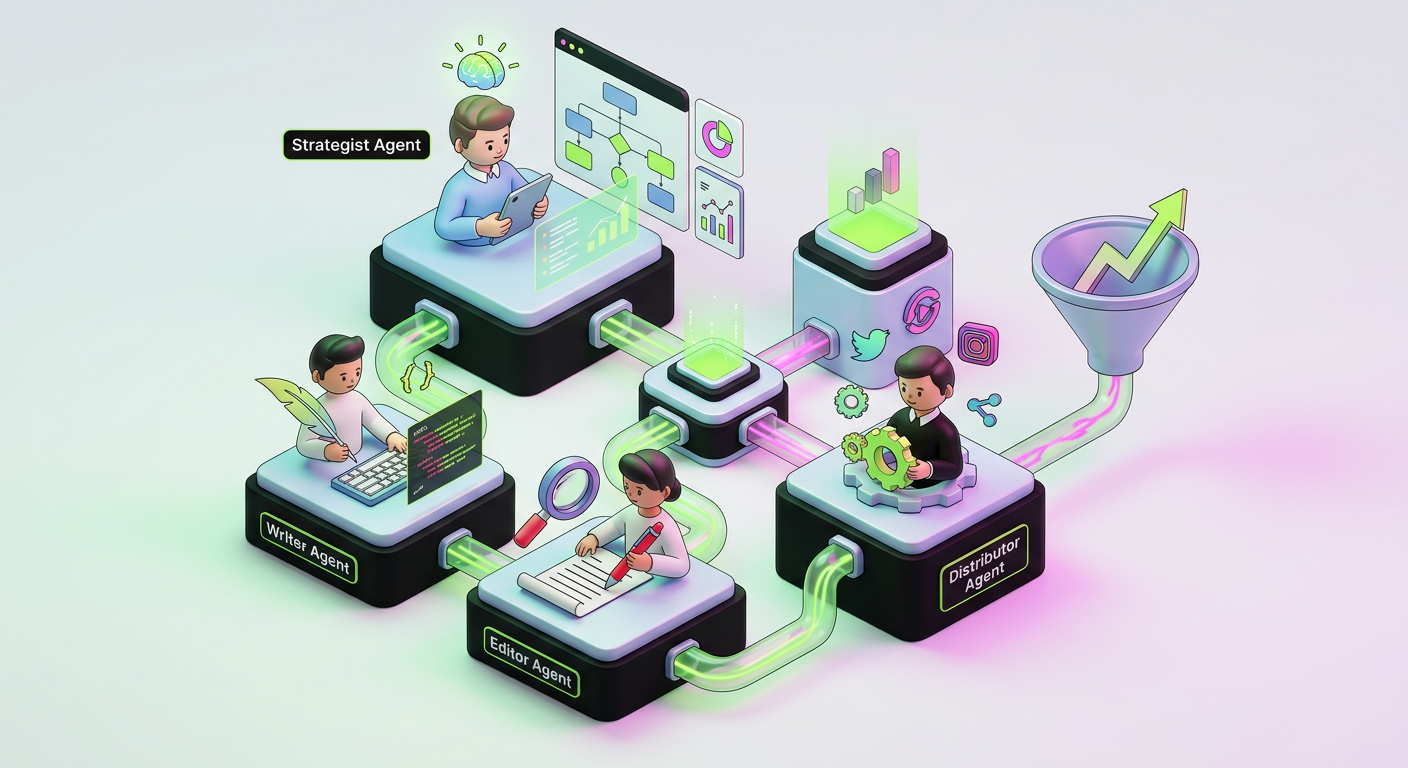
In early 2024, marketing automation was about generating a single blog post from a single prompt. By 2026, that approach is obsolete. Search engines now aggressively penalize "thin" AI content, leading to rapid traffic decay for those who prioritize volume over depth. Building AI agents today requires a shift in mindset: you are no longer a writer; you are a systems architect. You are designing a pipeline where specialized agents—Strategists, Writers, Editors, and Distributors—collaborate through a structured hand-off process.
The consensus among top-tier developers is that system architecture now outweighs the specific underlying model. Whether you use GPT-4, Claude 4.6, or a fine-tuned Llama variant, the magic happens in the orchestration. A well-designed swarm of agents can handle tasks that previously took a human team 2-3 days to complete, and they do it in minutes. However, without a rigorous framework, these agents produce generic, "hallucinated" garbage that destroys brand trust. To avoid this, we use the SOUL.md protocol.
Step 1: Defining the SOUL.md — The Identity Layer
The biggest failure in building AI agents is treating them as blank slates. Generic agents produce generic results. To solve this, frameworks like OpenClaw have popularized the "SOUL.md" file—a Markdown-based identity document that defines an agent's core existence. This isn't just a system prompt; it is a comprehensive job description, brand guide, and KPI sheet rolled into one file that the agent references for every action.
Why Your Agent Needs a SOUL
Without a SOUL.md, your "Writer Agent" will default to the average of its training data—usually a bland, corporate tone that screams "AI-generated." For a B2B SaaS company targeting CTOs or VPs of Engineering, this is a death sentence. Your audience craves technical depth and a specific point of view. A SOUL.md ensures that every output aligns with your unique value proposition and speaks the language of your specific niche.
Components of a High-Performance SOUL.md
- Role & Persona: Define exactly who the agent is. For example, "A cynical but brilliant Senior DevOps Engineer turned Content Marketer."
- Knowledge Boundaries: Explicitly state what the agent knows and, more importantly, what it doesn't know. This reduces hallucinations.
- Brand Voice Constraints: Use specific adjectives and examples. Instead of "professional," use "authoritative, data-heavy, and devoid of fluff."
- Success Metrics: Tell the agent how its work will be judged. If it's a Strategist Agent, its goal might be "identifying three high-intent keywords that competitors have overlooked."
- Interaction Protocols: Define how it should pass data to the next agent in the pipeline. This ensures the "Editor Agent" receives exactly what it needs to function.
Step 2: Architecting the Multi-Agent Pipeline
Once your identities are set, you must build the "factory floor." Building AI agents that work in isolation is useless; you need orchestration. A standard marketing pipeline for a B2B SaaS startup in 2026 follows a sequential, quality-first logic. The goal is to ensure that the "engine" is built and tested before the "paint" (SEO) is applied.
The Strategist Agent: The Brain
The pipeline starts with the Strategist. This agent doesn't write; it analyzes. It scours market trends, competitor whitepapers, and internal product roadmaps. Its output is a comprehensive content brief. In 2026, advanced Strategist Agents can even process real-time signals from neuro-contextual platforms to identify emerging pain points before they hit the mainstream. This agent ensures you aren't just creating content, but solving a specific problem for a specific buyer at the right time.
The Writer and Editor: The Production Core
The Writer Agent takes the brief and generates a technical draft. But the real work happens with the Editor Agent. This agent is programmed with a "No Fluff" protocol. Its job is to strip away empty adjectives, fix logical inconsistencies, and ensure the technical depth matches the SOUL.md requirements. This is where most teams fail—they skip the rigorous editorial step, leading to content that feels robotic. By separating the "creative" and "critical" functions into two different agents, you mirror the high-quality output of a human editorial room.
The SEO and Distributor: The Reach
Only after the content is polished does the SEO Agent touch it. This agent adds semantic richness, internal linking structures, and meta-data. Finally, the Distributor Agent takes the finished piece and multiplies it. A single core article is automatically transformed into five or more formats: a technical LinkedIn post, a condensed X thread, a newsletter snippet, and a personalized email drip for lead nurturing. This multiplier effect is how a solo founder can maintain the presence of a 10-person marketing department.
Step 3: Integrating Neuro-Contextual Intelligence
As of March 2026, the game has changed with the launch of tools like Seedtag’s "Liz." We are moving beyond simple keyword matching into neuro-contextual intelligence. This technology allows your agents to analyze up to 10 million URLs daily, identifying the emotional state and purchase intent of users in real-time. When building AI agents for distribution, you must integrate these signals to ensure your ads and content appear exactly when a prospect is feeling the "pain" your SaaS solves.
Real-Time Intent Mapping
Imagine your Distributor Agent detects a surge in frustration among DevOps engineers regarding rising cloud costs. Instead of a generic ad, it can trigger a specific campaign highlighting your SaaS’s cost-optimization features. This isn't just automation; it's precision targeting at scale. By leveraging neuro-contextual data, your agents can place your brand in the middle of high-intent conversations without manual intervention. This level of sophistication is what separates the 2026 leaders from those still stuck in the 2024 "post and pray" mindset.
Step 4: The Human-in-the-Loop (HITL) Mandate
Despite the power of autonomous systems, "automated authenticity" remains a myth. The dev community widely recognizes that 90% of "passive income AI" advice is garbage because it lacks quality control. To build a brand that lasts, you must implement Human-in-the-Loop (HITL) checkpoints. This prevents "cognitive deskilling"—the phenomenon where teams lose the ability to think critically because they rely too heavily on the machine.
Critical Checkpoints for Founders
- Strategic Approval: Before the Writer Agent starts, a human must sign off on the Strategist’s brief. Does this actually align with our Q3 revenue goals? AI can find trends, but it can't feel the pulse of your specific business strategy.
- The Final Polish: A human should always perform the final read of the Editor Agent’s output. This is where you add that last 5% of "soul"—the personal anecdote or the controversial opinion that an AI simply cannot replicate.
- Feedback Loops: Use the performance data from your Distributor Agent to coach your agents. If a certain style of LinkedIn post is tanking, update the SOUL.md for the Distributor Agent. This continuous iteration is the only way to maintain a competitive edge.
Troubleshooting the Autonomous Stack
When building AI agents, you will hit walls. The most common is the "Infinite Loop," where agents pass a bad draft back and forth without improvement. This usually stems from vague success metrics in the SOUL.md. If the Editor Agent doesn't know exactly what "good" looks like, it can't fix the Writer's mistakes. Another risk is cost overruns. Running a swarm of high-context models can get expensive. Smart architects use smaller, specialized models (like a fine-tuned Llama 3) for the Writer and Editor roles, reserving the heavy-duty models for Strategy and Final Review.
Factual inaccuracies are the final boss of AI marketing. In B2B SaaS, a single wrong technical claim can destroy your credibility. Your pipeline must include a "Fact-Checker Agent" that cross-references claims against a verified internal knowledge base or trusted external documentation. Even then, the human editor remains the ultimate safeguard against hallucinations.
The Future: Toward Full Autonomy
We are rapidly approaching a world of long-running independent tasks. OpenAI is projected to release an "autonomous AI research intern" by September 2026, with full multi-agent research labs expected by 2028. For the B2B SaaS founder, this means the virtual marketing department is just the beginning. Soon, agents will handle the entire sales funnel, from cold outreach to technical onboarding.
The winners in this new era won't be those with the biggest budgets, but those who can architect the most efficient, high-fidelity agentic systems. By focusing on SOUL.md identity, rigorous orchestration, and neuro-contextual targeting, you can build a marketing engine that works while you sleep, allowing you to focus on what actually matters: building a product that changes the world.