
Human Neurons Learn Doom in One Week
Cortical Labs, an Australian startup, recently advanced biologic computing. Their CL1 system integrates lab-grown human neurons with a silicon chip. This system learned to interact with the game Doom in about one week. This public demonstration in February 2026 marks a new frontier in computational capabilities.
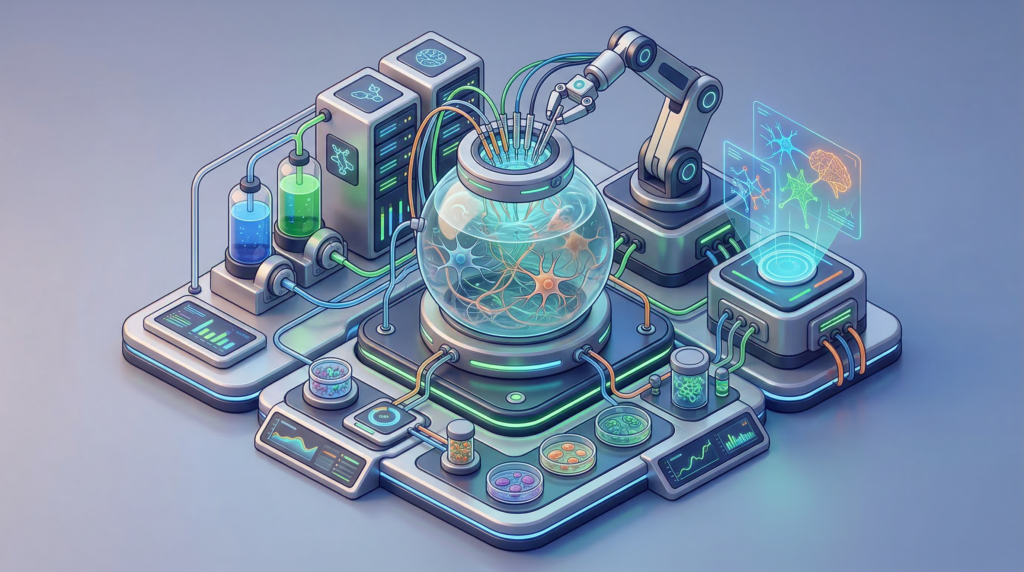
The CL1 system is a self-sufficient unit. It cultivates human neurons, derived from reprogrammed stem cells, on a 59-microelectrode array. An internal system maintains these cells for up to six months. It controls temperature, filtration, and gas composition. This setup allows sustained biological function in a controlled environment.
Adaptive Learning and Efficiency Gains
This development highlights the adaptive learning capabilities of biological neurons. They excel in dynamic, uncertain environments. This contrasts sharply with current silicon-based AI systems. The CL1’s performance shows an efficiency improvement over previous biological computing experiments.
The CL1 used 200,000 neurons to learn Doom in one week. The 2022 DishBrain experiment, by comparison, needed 800,000 neurons. It took 18 months to learn Pong. This represents a four-fold reduction in neuron count. Training time also decreased significantly. These gains stem from advancements in stimulation protocols and system architecture. The biOS (Biological Intelligence Operating System) facilitates this interaction. It converts digital data into electrical stimuli for the neurons. It then interprets their firings as computational outputs, primarily via a Python API.
Commercialization and Energy Considerations
Cortical Labs is commercializing this technology. They offer the CL1 for sale at $35,000 per unit. Racks of 30 units cost $20,000 per unit. They also provide “Wetware-as-a-Service (WaaS).” This allows users to rent processing time on live neurons through the Cortical Cloud, charged by usage. By 2025, 115 CL1 units had shipped to clients and research institutions.
The energy consumption of biologic computing is also notable. A rack of 30 CL1 units consumes between 850 and 1,000 Watts. An Nvidia H100 GPU, a high-performance silicon counterpart, typically consumes around 700 Watts. Direct comparative metrics are still evolving. However, the biological system shows promise in adaptive learning capacity per watt. This suggests potential for more energy-efficient AI solutions. This is especially true for tasks requiring rapid adaptation.
Applications Beyond Traditional AI
Immediate applications for CL1 technology span several areas. These include neuroscience research, offering a platform for studying neural networks. Pharmacological compound screening is another. Testing drugs on live human neurons provides a more accurate preclinical model. Advanced AI systems can also benefit. They can develop enhanced adaptive learning capabilities, moving beyond current algorithmic limitations.
Cortical Labs, founded in 2019 by Hon Weng Chong, has secured over $11 million in funding. Their focus positions biologic computing as a disruptive force. It offers solutions where traditional AI struggles with dynamic, unpredictable environments. The ability to rent processing time on live neurons through WaaS democratizes access to this nascent technology. This enables broader experimentation and development.