
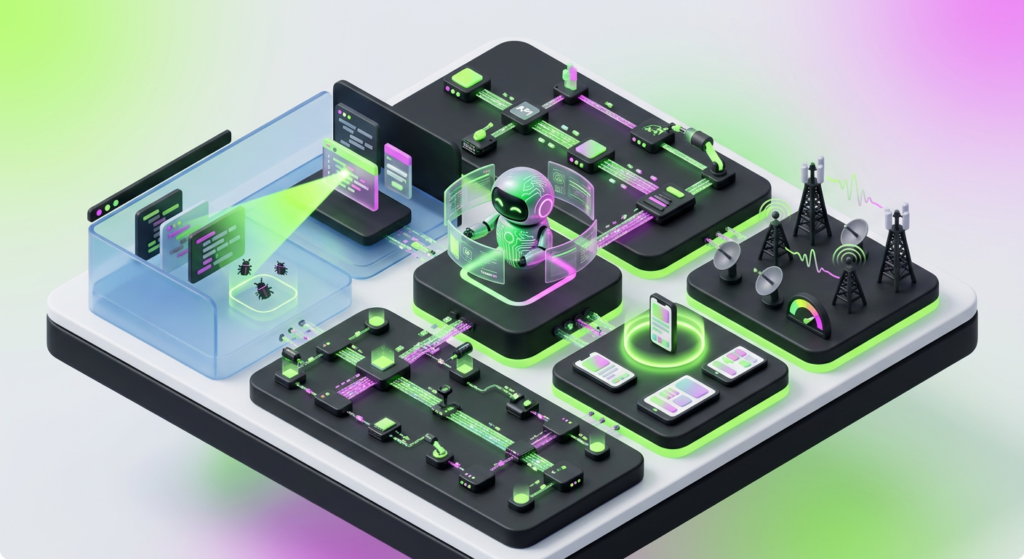
Automated software testing with AI has reached a tipping point in 2026, moving beyond simple script execution into the era of Agentic Engineering. The industry is abandoning the fragile, manual scripting of the past for autonomous agents that plan, execute, and maintain test suites without human intervention. This transition is driving a 40–50% reduction in engineering effort across the software development life cycle, according to data from platforms like BlueVerse Tech.
Self-Healing and Predictive Intelligence
Traditional automation often fails due to the "brittle script" problem—where minor UI changes break entire test suites. Modern automated software testing with AI solves this through self-healing capabilities. When a button ID or layout position changes, AI agents detect the shift and update test locators in real-time. This eliminates the tedious maintenance cycles that previously consumed 30% of a QA engineer's week.
Predictive testing further refines this process by analyzing historical code changes to forecast failure points. Instead of running bloated regression suites that take hours, teams now use "Smarter Regression" to target high-risk areas. Visual testing has also matured; current AI models understand layout logic rather than just comparing pixels, allowing them to distinguish between intentional design updates and actual UI glitches across varying device resolutions.
The OpenClaw Phenomenon and Enterprise Scale
A pivotal trend this year is the "OpenClaw" craze. This open-source agent orchestration system allows companies to build "AI versions of engineers" that handle coding and QA tasks 24/7. Startups like JustPaid have already leveraged these agent teams to build 10 major features in a single month—a workload that would typically require ten separate human developers working for a month each.
Enterprise adoption is equally aggressive. LTM, a global firm with 87,000 employees, recently deployed these AI-centric strategies across 40 countries. In March 2026, LTM launched FusionIQ, a platform specifically designed to accelerate enterprise test automation through AI-driven monitoring. This scale of implementation proves that automated software testing with AI is no longer a niche experiment but a core operational requirement.
Strategic Oversight: The New QA Role
The human element in quality assurance is shifting toward strategic oversight. With the February 2026 release of Anthropic’s Claude Code (Opus 4.6 model), autonomous coding and QA capabilities have reached a level where humans are better utilized for exploratory testing and user experience validation. The "2026 Guide to AI in Software Testing" confirms that while AI is an enhancement, it has permanently dismantled traditional testing models. Engineers now act as orchestrators of autonomous systems, ensuring that the speed of AI-led development does not compromise the nuance of human-centric design.