
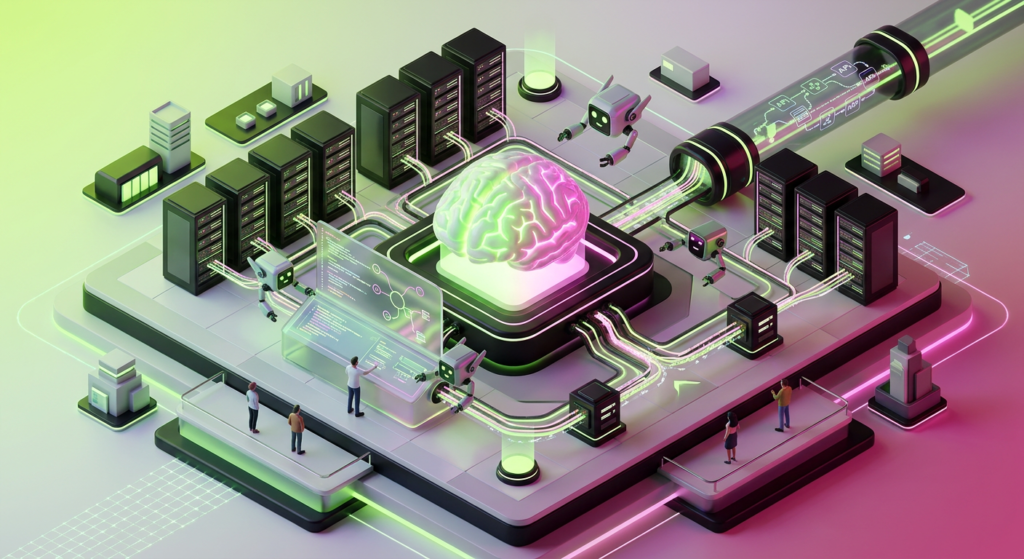
The landscape of artificial intelligence is shifting from static generative models to dynamic, autonomous AI agents. This transition, particularly prominent in 2026, demands a strategic approach to integrating AI APIs within enterprise environments. The core challenge lies not just in enabling agents to call external services, but in ensuring these interactions are secure, governed, and thoroughly tested. Modern engineering teams must move beyond simple prompt engineering to build systems that can execute complex workflows across fragmented software ecosystems.
Unlike traditional generative AI, which primarily focuses on content creation, agentic AI is designed for autonomous task execution. These agents employ reasoning to interact with the external world, leveraging tools and APIs to achieve complex objectives. This capability moves AI beyond content generation into active operational roles—a significant leap for enterprise applications. In 2026, the industry has moved past the 'chatbot' phase, focusing instead on agents that can manage supply chains, process insurance claims, or orchestrate cloud infrastructure without constant manual prompting.
This evolution is not merely theoretical. Industry investment is substantial, with high-stakes competitions like the EVE Frontier/GitLab hackathons offering prize pools up to $80,000. These events signal a clear market demand for practical, agent-based solutions that solve real-world connectivity problems. With major project deadlines approaching in April 2026, the pressure to move from experimental scripts to hardened, production-ready agent architectures has never been higher.
The Technical Core: Python for Integrating AI APIs
Python remains the undisputed language for AI agent development. Its rich ecosystem provides the necessary libraries for orchestrating API calls and building agent frameworks. Libraries like Requests and FastAPI facilitate robust API communication, while frameworks such as LangChain, CrewAI, and AutoGen offer the architectural scaffolding for agent logic. These tools allow developers to define 'tools'—essentially wrapped API functions—that the agent can call when its reasoning engine determines an external action is required.
At the heart of this integration is 'Function Calling' or 'Tool Use.' This mechanism allows a Large Language Model (LLM) to identify the appropriate API based on a user's intent, then format and execute the necessary JSON payload. This capability transforms an LLM from a conversational interface into an active participant in business processes. When an agent encounters a task it cannot solve with internal weights alone, it consults its tool manifest, selects the correct endpoint, and generates the structured data required for the call.
When an AI agent needs to perform an action that extends beyond its internal knowledge base, it follows a specific execution loop. First, the LLM interprets the user's request and determines that an external tool is required. It then identifies the specific API or function from its available tools that can fulfill the request. The LLM extracts the necessary parameters from the user's prompt to populate the API call, and the agent framework executes the call. Finally, the API's response is fed back to the LLM for further reasoning or to formulate a user-facing answer.
Addressing the Oversight Gap: Human-in-the-Loop
One of the most common pitfalls in enterprise AI agent development is over-automation without adequate human oversight. Agents, by their autonomous nature, can execute actions with significant real-world implications. Without a 'human-in-the-loop' (HITL) mechanism, critical decisions or irreversible actions can occur without validation. This is especially dangerous when integrating AI APIs that have 'write' access to production databases or financial gateways.
Implementing HITL is not about stifling automation; it's about strategic intervention. For sensitive operations—such as financial transactions, data modifications, or critical system reconfigurations—agents should be designed to pause and request human approval. This ensures accountability and mitigates the risk of unintended consequences. In a 2026 enterprise environment, an agent might draft an entire procurement order, but the final 'send' button remains under human control.
Consider HITL for scenarios involving high-value transactions or any action that moves significant financial resources. Data privacy is another critical area; operations that access, modify, or share sensitive customer or proprietary data must be gated. Furthermore, actions that could impact core business systems or infrastructure require a 'sanity check' by a human operator. When the agent's confidence score for a specific action falls below a predefined threshold, the system should default to human intervention rather than guessing.
The Governance Void: Establishing Auditability and Control
Ignoring governance in AI agent deployment leads to significant enterprise risks, particularly concerning API rate limits and data privacy. Autonomous agents can, if unchecked, overwhelm external services or inadvertently expose sensitive information. A robust governance framework is essential for maintaining control and ensuring compliance. Without centralized logging, an agent could enter an infinite loop of API calls, racking up massive costs or triggering security blocks before a human notices the error.
Effective governance involves logging every agent action, API call, and decision point. This creates an auditable trail, crucial for debugging, performance analysis, and regulatory compliance. Moreover, defining clear policies for API usage, data handling, and error management prevents agents from operating in a black box. In 2026, 'Explainable AI' isn't just about the model's weights; it's about the traceability of the agent's actions across the network.
Key governance considerations include action logging to record every decision and its outcome. Rate limit management is also vital; developers must implement mechanisms to prevent agents from exceeding API quotas, potentially through token buckets or circuit breakers. Data masking and anonymization ensure sensitive data is handled according to privacy regulations before being processed by agents. Finally, granular access control defines which agents can access specific APIs and data sources, preventing 'privilege escalation' within the AI layer.
Secure API Authorization: The 'Authorized to Act' Principle
As of March 2026, the focus on secure API authorization for AI agents has intensified. Solutions like Auth0 by Okta are specifically being positioned to ensure agents are 'Authorized to Act.' This goes beyond simple API keys stored in environment variables; it involves granting agents specific, scoped permissions, much like human users. If an agent is compromised, its blast radius is limited to the specific scopes it was assigned.
Implementing robust authentication and authorization layers is paramount. Agents must present valid credentials for every API interaction, and these credentials should adhere to the principle of least privilege. This minimizes the attack surface and prevents unauthorized access or misuse of enterprise resources. Using OAuth 2.0 and OpenID Connect allows for secure delegation of access, ensuring the agent acts only on behalf of a verified user or service account.
Robust authorization requires scoped permissions, granting agents only the minimum necessary access for their tasks. Token rotation is another necessity, regularly refreshing access tokens to reduce the risk of compromise. Centralized identity management integrates agents into existing enterprise identity systems, allowing security teams to revoke an agent's access instantly if suspicious behavior is detected. This level of control is what separates a 'toy' project from an enterprise-grade AI deployment.
Beyond Unit Tests: Scenario-Based Integration Testing
Poor integration testing is a critical failure point in enterprise AI agent development. Traditional unit tests, while important, are insufficient for autonomous agents interacting with complex external systems. Agents require scenario-based testing that simulates real-world interactions and validates end-to-end workflows. Because LLM outputs are non-deterministic, testing must account for variations in how an agent might attempt to solve a problem.
This means moving beyond testing individual API endpoints in isolation. Instead, engineers must test entire agentic sequences: from intent recognition, through multiple API calls, to final output. This approach uncovers issues related to unexpected API responses, error handling, and the agent's ability to recover from failures. If an API returns a 500 error, does the agent retry, try an alternative tool, or crash? Integration testing provides these answers.
Effective strategies include designing end-to-end scenarios that mimic full user journeys. Mocking external services allows developers to simulate various responses, including errors and edge cases, without impacting live systems. Regression testing ensures that as the agent's underlying model or logic evolves, it doesn't lose the ability to perform core tasks. Performance testing evaluates how agents handle concurrent requests and high volumes of API calls, which is essential for scaling to thousands of users.
Context: From Chatbots to Autonomous Operations
The evolution of AI from late 2023 to the present day marks a significant shift. Initially, LLMs were primarily seen as advanced chatbots or content generators. However, the introduction and standardization of 'Function Calling' across major providers like OpenAI, Anthropic, and Google in 2025 transformed their utility. This capability enabled LLMs to become proactive agents, capable of executing tasks rather than just responding to queries. The 'brain' finally gained 'hands.'
Now, in March 2026, the industry has matured to prioritize enterprise-grade concerns: security, governance, and reliable integration. The focus is no longer just on what an agent can do, but how it does it—securely, accountably, and effectively within a complex organizational structure. Organizations are now building 'Agent Ops' teams to manage the lifecycle of these autonomous entities, ensuring they remain aligned with business goals and security policies.
Integrating AI APIs for enterprise agent development presents both immense opportunities and significant challenges. The ability of agents to autonomously execute tasks via external services can unlock unprecedented efficiencies. However, this power must be wielded with precision. By prioritizing robust security, establishing clear governance, and conducting rigorous scenario-based testing, organizations can successfully deploy AI agents that scale their impact without introducing undue risk. The next frontier is not just more powerful models, but more reliable and authorized integrations.