
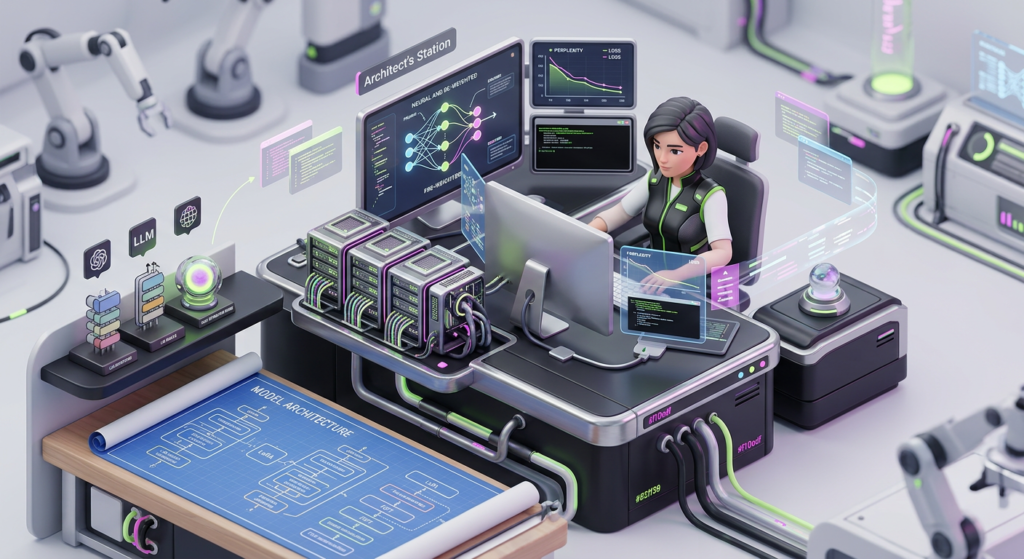
The landscape of large language models (LLMs) shifted fundamentally in early 2026. What was once the exclusive domain of elite research labs—requiring massive server clusters and million-dollar budgets—is now accessible on a single desktop. The democratization of AI means the primary barrier to entry is no longer compute power, but technical expertise. Mastering the art of fine-tuning LLMs allows developers to move beyond generic prompting and build specialized, private, and highly efficient systems tailored to specific industrial or creative needs.
Hardware constraints, previously the biggest hurdle for local development, have largely evaporated. In 2026, a standard 12GB consumer GPU is sufficient to handle 8-billion-parameter models like Llama 3.1 or Qwen 2.5. This shift enables a rapid iteration cycle that cloud-based providers cannot match, especially when data privacy and latency are non-negotiable. This guide provides the technical roadmap to navigate this new ecosystem, focusing on the tools and methodologies that define modern AI engineering.
The Hardware Shift: Local Compute as a Viable Platform
Fine-tuning LLMs is no longer a cloud-only endeavor. The emergence of highly optimized kernels and quantization techniques has turned personal machines into viable development platforms. While enterprise-grade A100 or H100 GPUs remain the gold standard for massive scale, the individual architect now leverages consumer-grade hardware to achieve professional results. This transition is driven by the realization that most specialized tasks do not require a 400B parameter model; a finely tuned 8B model often outperforms its larger counterparts on specific domain logic.
Memory management remains the central challenge. Even with 2026-era optimizations, VRAM (Video RAM) is the most precious resource. A 12GB buffer is the baseline for 8B models, but the introduction of frameworks like Unsloth has pushed these requirements even lower. Developers now experiment with 7B or 8B models on hardware with as little as 6GB of VRAM by utilizing aggressive 4-bit quantization. This accessibility means the focus has moved from 'how do I afford the compute?' to 'how do I optimize the training loop?'
Local development offers a level of security that third-party APIs cannot guarantee. For industries dealing with sensitive medical, legal, or proprietary codebases, the ability to keep data within a local environment while fine-tuning is the only path forward. This 'local-first' approach is the hallmark of the 2026 AI architect, prioritizing data sovereignty alongside model performance.
Parameter-Efficient Fine-Tuning (PEFT) and the QLoRA Standard
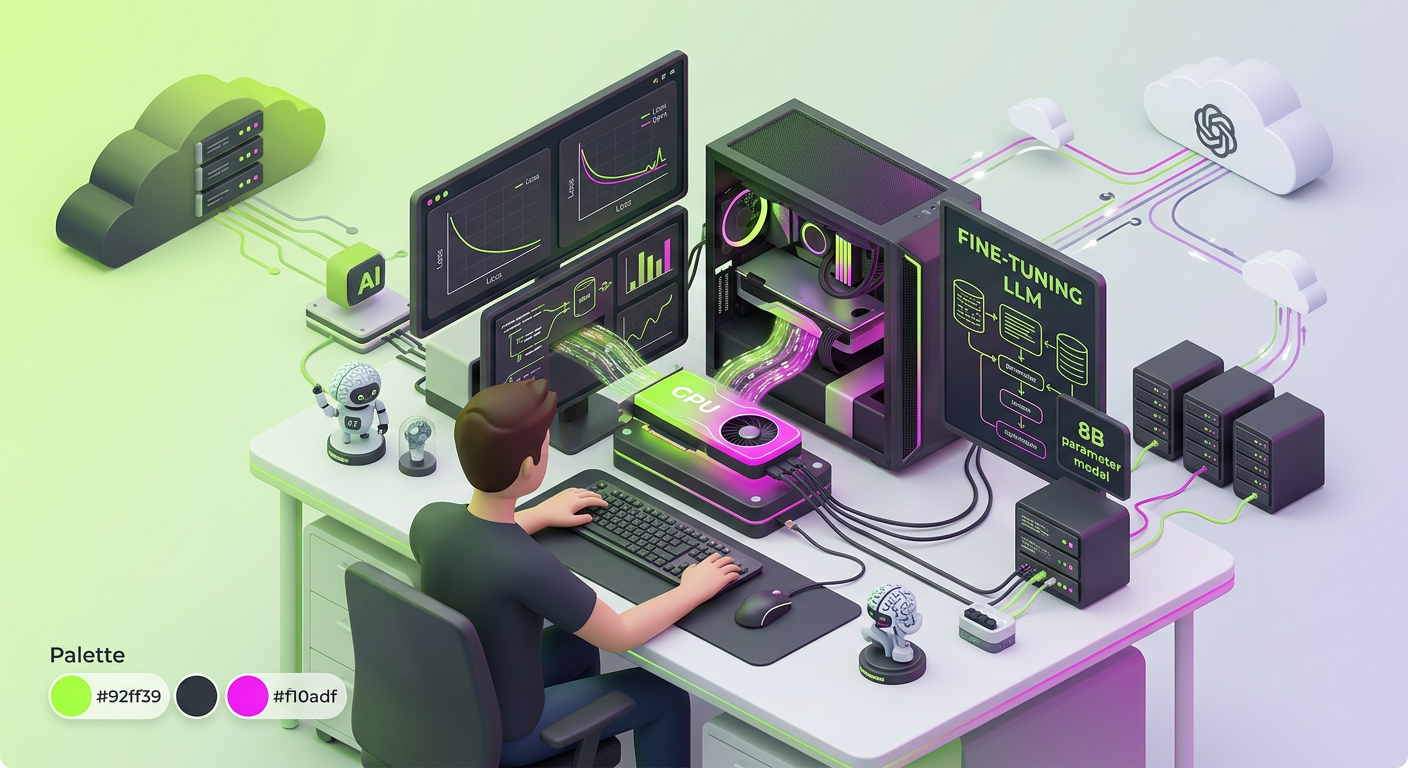
Full fine-tuning—updating every single weight in a model—is increasingly rare outside of foundational model training. It is computationally expensive and prone to 'catastrophic forgetting,' where the model loses its general reasoning capabilities while learning a new task. Instead, the industry has standardized on Parameter-Efficient Fine-Tuning (PEFT). This methodology focuses on modifying a tiny fraction—often less than 1%—of the model's total parameters.
QLoRA (Quantized Low-Rank Adaptation) stands as the bedrock of this strategy. By applying 4-bit quantization to the base model and adding small, trainable adapter layers, QLoRA reduces memory consumption by up to 75%. This efficiency does not come at the cost of accuracy; research consistently shows that QLoRA-tuned models match the performance of full-parameter fine-tuning on most downstream tasks. For the developer, this means the ability to run training sessions on a single GPU that would have required a multi-node cluster three years ago.
Implementing QLoRA requires a deep understanding of rank (r) and alpha parameters. The rank determines the size of the adapter layers; a higher rank allows the model to learn more complex patterns but increases memory usage and the risk of overfitting. In 2026, the consensus for most instruction-tuning tasks is a rank between 16 and 64. Balancing these hyperparameters is the technical core of fine-tuning LLMs, requiring a blend of empirical testing and theoretical understanding of linear algebra.
Unsloth: Accelerating the Training Pipeline
If QLoRA provides the memory efficiency, Unsloth provides the raw speed. This framework has become the essential tool for local fine-tuning LLMs, offering training speeds up to 2x faster than standard Hugging Face implementations. Unsloth achieves this by rewriting the backpropagation kernels in OpenAI’s Triton language, optimizing the mathematical operations specifically for NVIDIA GPUs. This isn't a marginal gain; it is a workflow transformation.
Speed is not just about saving time; it is about the ability to fail fast and iterate. In a traditional setup, a training run might take six hours. If the loss curve explodes or the model starts hallucinating, you’ve lost half a day. With Unsloth, that same run takes less than three hours. This allows for multiple experiments within a single workday, enabling the architect to test different learning rates, dataset mixtures, and prompt templates with unprecedented frequency.
Unsloth also introduces 'Long Context' support, allowing developers to fine-tune models on documents that were previously too large for consumer hardware. By optimizing memory allocation during the attention mechanism, it is now possible to train on sequences of 8,000 to 16,000 tokens without crashing the system. This capability is vital for building models that need to analyze long legal contracts or complex code repositories, tasks that were previously reserved for high-end server hardware.
Dataset Curation: Solving the Quality Bottleneck
With hardware and software optimizations largely solved, the true bottleneck in fine-tuning LLMs is data quality. A model is a reflection of its training set. In 2026, the 'garbage in, garbage out' rule is more relevant than ever. High-quality fine-tuning typically requires between 500 and 10,000 meticulously curated examples. Simply scraping the web or dumping raw logs into a trainer will result in a model that parrots noise rather than providing value.
Effective curation involves three stages: cleaning, formatting, and balancing. Cleaning removes duplicates, boilerplate text, and low-quality responses. Formatting ensures the data matches the specific instruction template (like Alpaca or ShareGPT) that the model expects. Balancing is perhaps the most critical; if your dataset is 90% Python code and 10% documentation, the model will struggle to explain the code it writes. An architect must ensure the dataset represents the full breadth of the desired behavior.
Harvard Business Review research from March 2026 highlighted a phenomenon called 'Strategy Trendslop.' This occurs when LLMs are trained on generic business jargon, leading them to provide advice that sounds professional but lacks context-specific logic. To avoid this, architects must use 'synthetic data evolution'—using a stronger model (like GPT-5 or Llama 3.1 405B) to critique and improve a local dataset before using it for fine-tuning. This 'teacher-student' approach ensures the local model learns high-level reasoning rather than just mimicking buzzwords.
Alignment Techniques: DPO and the Path to Human Intent
Fine-tuning for task completion is only the first step. To make a model truly useful, it must be aligned with human preferences. In 2026, Direct Preference Optimization (DPO) has largely superseded Reinforcement Learning from Human Feedback (RLHF) for local developers. RLHF requires maintaining a separate reward model, which is computationally heavy and unstable. DPO, conversely, treats alignment as a simple classification task, making it much easier to implement on limited hardware.
Alignment ensures the model is not just accurate, but also helpful and safe. It prevents the model from becoming overly verbose or 'preachy'—a common complaint with early AI models. By providing the model with pairs of 'preferred' and 'rejected' responses, the architect guides the LLM toward a specific tone and style. This is where the personality of the AI is forged. Whether you need a concise technical assistant or a creative writing partner, DPO is the tool that shapes that identity.
Beyond DPO, new techniques like KTO (Kahneman-Tversky Optimization) are gaining traction. These methods focus on the psychological aspects of human decision-making to better predict what kind of output a user will find satisfying. For the LLM architect, staying updated on these alignment strategies is as important as knowing how to code the training loop. The goal is to create a system that feels intuitive and reliable, reducing the friction between human intent and machine execution.
On-Device Personalization and the 2027 Horizon
The future of fine-tuning LLMs is moving toward the edge. While we currently focus on desktop GPUs, the next frontier is real-time personalization on mobile and IoT devices. The 'SoulMate' AI semiconductor, presented at the ISSCC in February 2026, represents this shift. This chip operates at a mere 9.8mW—1/500th the power of a standard smartphone processor—yet it can perform LoRA-based updates and RAG (Retrieval Augmented Generation) in just 0.2 seconds.
This technology, set for commercialization in 2027 via 'OnNeuro AI,' suggests a world where your phone learns your specific habits and preferences locally, without ever sending data to a central server. As an architect, understanding the principles of fine-tuning today prepares you for this decentralized future. The skills used to optimize an 8B model on a PC are the same skills that will be used to personalize 'micro-models' on wearable tech and smart home systems.
We are moving away from a world of 'one-size-fits-all' AI. The future belongs to hyper-personalized systems that understand the specific context of their users. By mastering local fine-tuning now, you are positioning yourself at the forefront of this transition. The ability to take a base model and transform it into a specialized tool is the most valuable skill in the 2026 tech economy.
Troubleshooting and Advanced Optimization
Even with the best tools, fine-tuning LLMs often involves technical hurdles. The most common issue is 'gradient explosion,' where the model's loss suddenly spikes to infinity. This is usually caused by a learning rate that is too high or a batch size that is too small. Architects should always use a learning rate scheduler and start with a 'warmup' phase to stabilize the weights during the initial steps of training.
Another frequent pitfall is neglecting the evaluation phase. It is easy to get excited by a low training loss, but that doesn't always translate to a better model. You must maintain a separate 'validation set' that the model never sees during training. Periodically testing the model on this set provides an unbiased view of its progress. If the training loss goes down while the validation loss goes up, the model is overfitting—it’s memorizing the data rather than learning the underlying logic.
For those looking to push the limits, 'Incremental Fine-Tuning' is a powerful strategy. Instead of training on all your data at once, you can train the model in stages. Start with a broad dataset to establish general domain knowledge, then move to a highly specialized dataset for the final polish. This hierarchical approach often results in a more robust model that retains its general reasoning while excelling at its primary task. Monitoring for 'catastrophic forgetting' during these stages is essential; always include a small percentage of general-purpose data in your specialized sets to keep the model's core intelligence intact.