
TL;DR
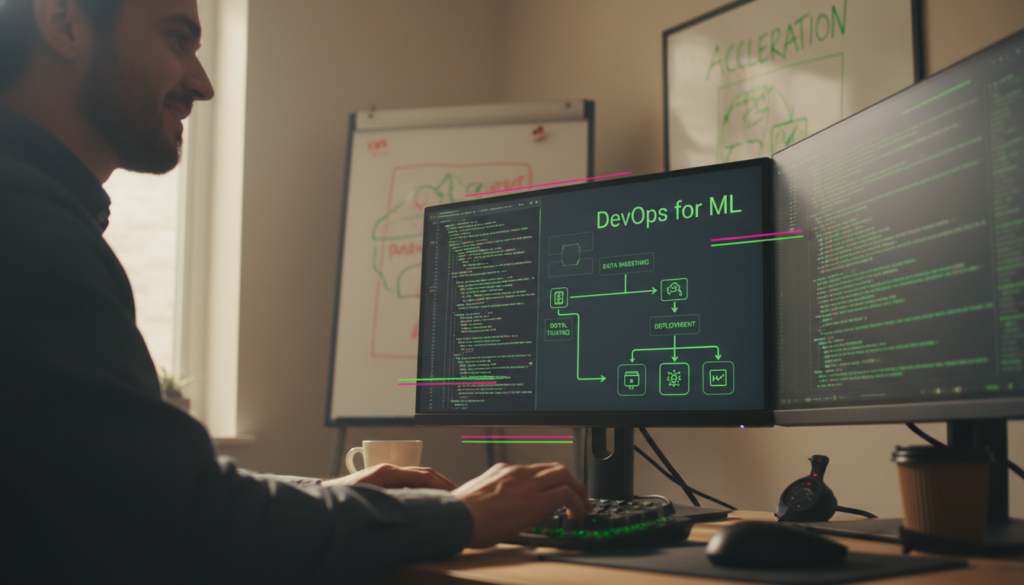
DevOps principles, when applied to machine learning—a practice known as MLOps—significantly enhance the efficiency and reliability of AI development. This guide outlines the core concepts of both DevOps and ML, then details how to bridge the gap by integrating continuous practices, automation, and robust monitoring into your machine learning lifecycle. Expect to learn about essential skills, critical tools, and the practical steps needed to implement MLOps effectively.
1. Understanding DevOps Fundamentals
Before you can apply DevOps to machine learning, you must grasp its core tenets. DevOps, a portmanteau of “Development” and “Operations,” represents a cultural and technical shift. It aims to unify software development and operations, fostering collaboration throughout the entire software lifecycle. The goal, ultimately, is to deliver software faster, more reliably, and with fewer errors.
This approach emphasizes automation, continuous integration, continuous delivery, and constant feedback loops. Think of it this way: instead of siloed teams, you have a shared responsibility for the product from code commit to production deployment. It’s a philosophy that prioritizes speed and stability.
Key Benefits of DevOps
DevOps brings several advantages to any software project. For instance, you get faster and more frequent software releases. Automation, a cornerstone of DevOps, drastically reduces manual errors, ensuring more consistent deployments. Furthermore, built-in monitoring capabilities allow for quick identification and resolution of issues, while automated testing catches bugs earlier in the cycle. This means fewer headaches for everyone involved.

2. Grasping Machine Learning Essentials
Machine learning (ML) is a subset of artificial intelligence, focusing on building systems that learn from data without explicit programming. It’s about enabling computers to identify patterns and make predictions or decisions based on those patterns. If you’ve ever wondered how Netflix recommends movies, you’re seeing ML in action.
Types of Machine Learning
Primarily, ML encompasses three main categories: Supervised Learning, Unsupervised Learning, and Reinforcement Learning. Supervised learning involves training models on labeled datasets, while unsupervised learning deals with unlabeled data to find hidden structures. Reinforcement learning, conversely, focuses on agents learning through trial and error in an environment. You might also encounter Self-Supervised Learning and Semi-Supervised Learning, which blend aspects of these core types. Each type has its own strengths and ideal use cases.
The Machine Learning Pipeline
An ML project follows a distinct pipeline. It starts with Data Preprocessing—cleaning, transforming, and preparing your data. This involves steps like feature scaling, extraction, engineering, and selection. Next, Exploratory Data Analysis (EDA) helps you understand the data’s characteristics and identify potential relationships. Finally, Model Evaluation assesses your model’s performance and generalization capabilities. Each stage requires careful attention to detail, as errors here can propagate through the entire system, much like a domino effect.
3. Bridging the Gap: Why DevOps for Machine Learning Matters
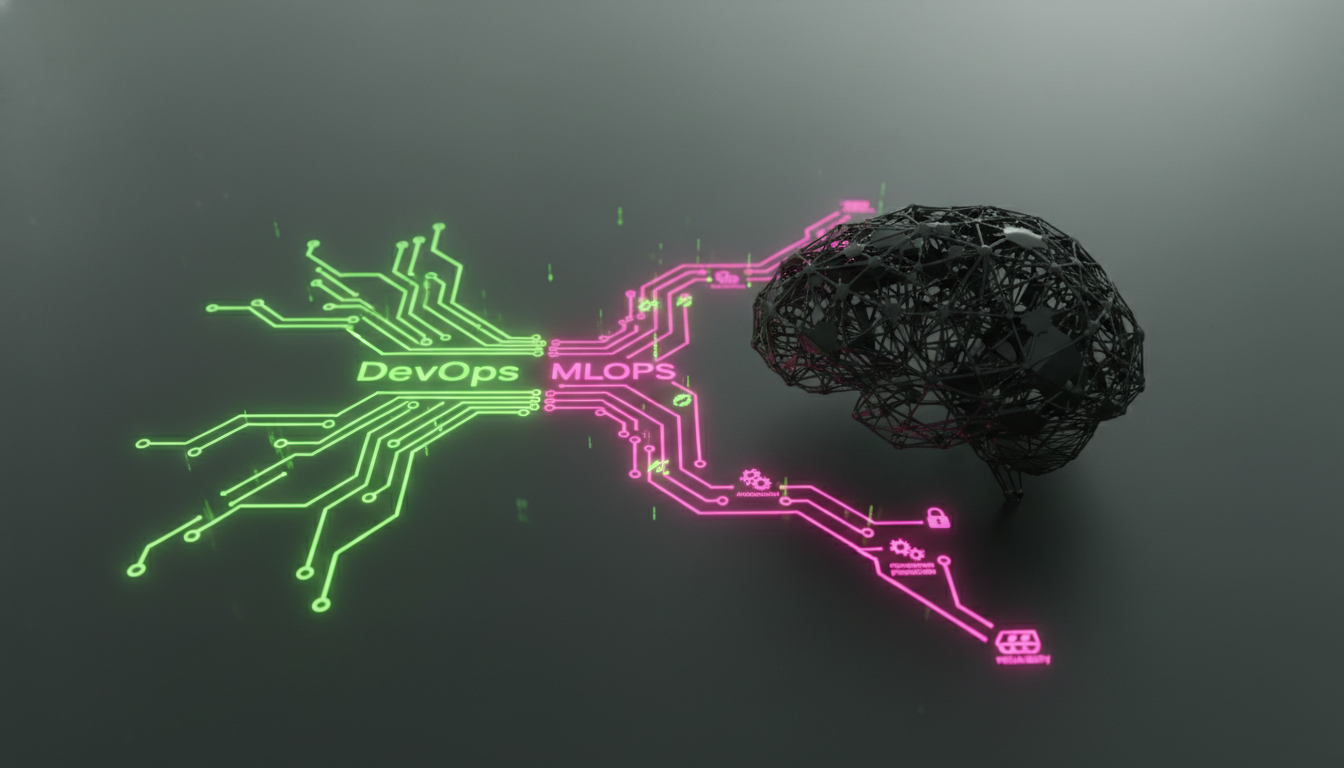
Traditional DevOps practices, while powerful, don’t directly translate to machine learning without adaptation. The unique characteristics of ML—data dependency, experimental nature, and the need for continuous retraining—demand a specialized approach: MLOps. MLOps extends DevOps principles to the entire machine learning lifecycle, from data collection and model development to deployment, monitoring, and retraining. It’s about bringing order to the often chaotic world of ML development.
Consider the challenges: data changes over time, model performance can degrade, and experiments need rigorous tracking. Without MLOps, these issues lead to slow deployments, inconsistent model behavior, and difficulty reproducing results. MLOps addresses these by bringing automation, version control, and continuous practices to every stage of your ML projects. This ensures your models remain relevant and performant in the real world.
4. Mastering Essential MLOps Skills
To effectively implement DevOps for machine learning, you need a blend of traditional DevOps expertise and specific ML knowledge. Here’s what to focus on:
- Operating Systems & Linux Fundamentals: Understand shell navigation, file permissions, process management, and text manipulation. Systemd knowledge is also important for managing services. These are the building blocks of any robust system.
- Networking Fundamentals: A solid grasp of the OSI Model, TCP/IP, common protocols (DNS, HTTP/HTTPS), and network security concepts (firewalls, VPNs) is indispensable. You’ll also need to understand CDNs, ports, and load balancers. After all, your models need to communicate!
- Version Control with Git: This is non-negotiable. Master basic commands, branching strategies, and conflict resolution. Familiarity with platforms like GitHub, GitLab, or Bitbucket is essential for collaborative development. How else will you track changes and work together?
- Programming & Scripting Skills: Bash or PowerShell are vital for scripting automation tasks. Python or Go are necessary for complex automation, especially when interacting with Cloud APIs and building ML pipelines. Python, in particular, is the lingua franca of machine learning. You’ll be writing a lot of code, so be prepared.
- Machine Learning Specifics: Beyond general programming, you need to understand ML frameworks (e.g., TensorFlow, PyTorch), data processing libraries (e.g., Pandas, NumPy), and model evaluation metrics. Knowledge of MLOps tools (e.g., MLflow, Kubeflow, DVC) is also highly beneficial. This specialized knowledge sets you apart.
5. Implementing DevOps for Machine Learning: Step-by-Step
Applying DevOps for machine learning requires a structured approach. Break down the complex ML lifecycle into manageable, automated steps. This makes the entire process less daunting.
Step 1: Version Control Everything
Start by versioning all assets. Use Git for your code—this includes model training scripts, inference code, and infrastructure configurations. However, for MLOps, you must also version your data and models. Tools like Data Version Control (DVC) allow you to track large datasets and model artifacts, ensuring reproducibility. This way, you can always revert to a previous state or reproduce an experiment with specific data and model versions. It’s like having a time machine for your project.
Step 2: Automate Data Pipelines
Data is the lifeblood of ML. Automate your data ingestion, cleaning, transformation, and feature engineering processes. Use orchestration tools to schedule these pipelines and ensure data quality checks are in place. For instance, you can use Apache Airflow or Kubeflow Pipelines to manage complex data workflows. This reduces manual effort and minimizes errors, freeing you up for more complex tasks.
Step 3: Streamline Model Training and Experimentation
Automate the model training process. This means setting up continuous integration (CI) pipelines that trigger training runs when new code or data becomes available. Crucially, track all experiments—hyperparameters, metrics, and model artifacts. Tools like MLflow or Weights & Biases help manage this complexity, providing a centralized repository for experiment results. This allows for easy comparison and selection of the best performing models. You’ll know exactly what worked and why.
Step 4: Automate Model Deployment
Once a model is trained and validated, automate its deployment to production. Use containerization technologies like Docker to package your model and its dependencies. Orchestration platforms like Kubernetes can then manage the deployment, scaling, and self-healing of your model inference services. This ensures consistent environments and rapid deployment cycles. Imagine deploying a new model with a single command!
Attention: Ensure your deployment strategy includes rollback mechanisms. If a new model performs poorly, you must be able to quickly revert to a previous, stable version. This is your safety net.
Step 5: Implement Continuous Monitoring
Monitoring in MLOps goes beyond infrastructure health. You need to monitor your model’s performance in production for data drift and concept drift. Data drift occurs when the characteristics of the input data change over time, while concept drift means the relationship between input and output changes. Set up alerts for performance degradation, data anomalies, and infrastructure issues. This proactive approach helps maintain model accuracy and reliability. It’s about keeping your models sharp and effective.
6. The Future of MLOps: AI-Assisted Automation
Advanced AI models, such as GPT-5.4, offer intriguing possibilities for the future of MLOps. With its 1 million token context window and enhanced tool-calling capabilities, GPT-5.4 could significantly assist in automating various MLOps tasks. Imagine AI generating boilerplate code for data pipelines, suggesting optimal model architectures, or even identifying potential sources of data drift based on monitoring logs. This could be a game-changer.
GPT-5.4’s improved factual accuracy—33% fewer incorrect claims and 18% fewer errors compared to GPT-5.2—suggests it could become a reliable assistant for complex engineering tasks. For example, it might help interpret complex monitoring data or even auto-generate documentation for MLOps pipelines. This could further reduce development time and enhance the overall efficiency of MLOps workflows, ultimately accelerating AI development and deployment. Are we on the cusp of truly autonomous MLOps?
What Comes Next?
Implementing MLOps is an ongoing journey. Start with small, manageable steps, focusing on automating the most critical parts of your ML pipeline. Continuously iterate, gather feedback, and refine your processes. The goal is to create a robust, scalable, and reliable system for delivering high-quality machine learning models to production. Your investment in MLOps will pay dividends in faster innovation and more dependable AI solutions. What part of your ML workflow will you automate first?